Home / Dependent Care Assistance DCAP FSA Plan Documents - $149 one-time fee
Dependent Care Assistance Plan (DCAP) FSA Plan Documents – $149 one-time fee
Roll over image to zoom in
With the Core DCAP FSA employees save $1,500 to $2,000 and employers save $382 per employee in payroll taxes on tax-free daycare expenses.
$149 one-time fee in PDF via email*
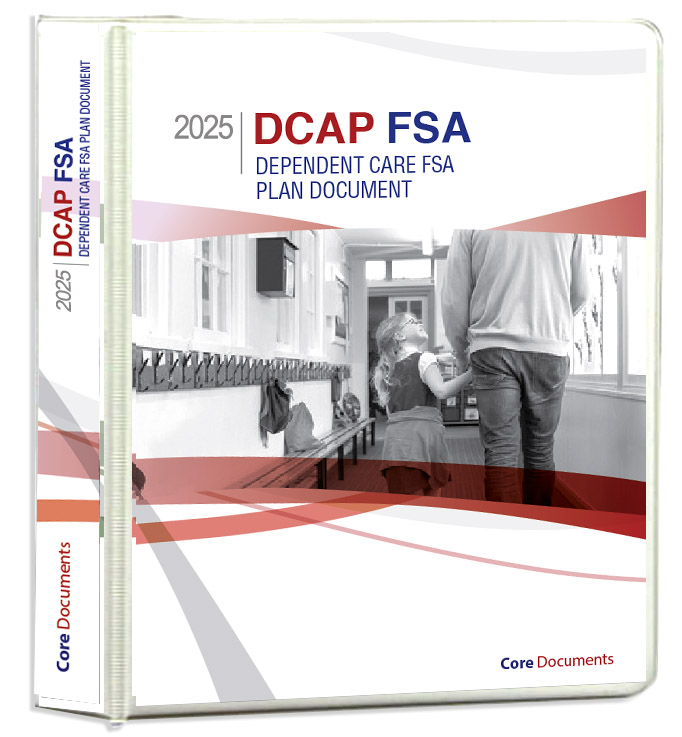
$199 one-time fee in PDF email* + Deluxe Binder
Section 129 of the IRS Code allows employers to establish a plan so their employees can elect to set aside up to $5,000 annually in 2025 in a special tax-free savings account called a Dependent Care Assistance Plan FSA, or DCAP FSA. Employees can save up to 30% in income taxes on that $5,000 (approximately $1,500 to $2,000). Employers who sponsor the DCAP FSA can save 7.65% in matching FICA taxes on each $5,000 deduction; approximately $382 per employee.
ABOUT Dependent Care FSA Plan Document PACKAGE
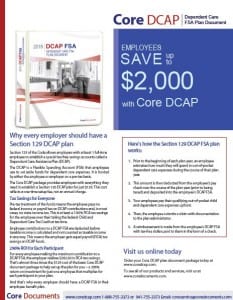
Employees can set aside up to $5,000 annually ($2,500 per spouse when married and filing separately) in pre-tax salary deductions to pay for dependent care necessary for the employee to be able to work or attend school full-time. Employees can save up to 30% in income taxes on that $5,000 (approximately $1,500 to $2,000). Employers who sponsor the DCAP FSA can save 7.65% in matching FICA taxes on each $5,000 deduction; approximately $382 per employee.

Managing the cost of child care
For most families, paying for child care so that both parents can work is an escalating burden. The cost for
daycare can be higher than housing or a year of in-state college tuition. Here are some examples of averages by state:
|
Cost of
Child Care |
| State |
Housing |
College tuition |
4-year-old |
Infant |
| Colorado |
$13,829 |
$9,540 |
$12,390 |
$15,325 |
| Indiana |
$9,613 |
$9,038 |
$9,557 |
$12,612 |
| Minnesota |
$11,137 |
$11,226 |
$12,252 |
$16,087 |
| Vermont |
$11,616 |
$16, 103 |
$11,717 |
$12,812 |
Annual expense data from Economic Policy
Institute, The Cost of Childcare, July 2019. |
DCAP FSA vs. tax credits
Employers providing access to a DCAP FSA show interest in employees’ well-being and that of their family, with a pre-tax benefit better than any other tax savings available, including the federal dependent care
tax credit.
The Child and Dependent Care Credit provides as much as $1,050 per child for up to two children, or 35% of up to $3,000. Problem is, the more parents earn, the smaller the credit, the credit only comes at the end of the year, and it is not a refundable tax credit.
See a Dependent and Child Care Credit worksheet at: https://www.irs.gov/pub/irs-pdf/f2441.pdf
By comparison, an employer-sponsored DCAP FSA benefit allows a tax benefit on up to $5,000 in dependent care expenses and the savings increases as parents generate higher incomes and are taxed at higher rates. Parents also save the 7.65% Social Security FICA tax on that $5,000. There is no waiting for the benefit at the end of the year and, it’s even better than a refundable credit because it’s money that stays in the parents’ hands in the first place.
Best of all, the employer is spared as much as 10% in payroll taxes on employees’ pre-tax DCAP FSA deposits.
Getting started
Employers thinking about adding a Dependent Care Assistance FSA benefit can do so simply by establishing a
written plan document (an IRS requirement) and distributing a benefit summary plan description to every employee
(as required by the Department of Labor).
Core Documents provides employers with everything necessary to establish a Section 129 Dependent Care Assistance
FSA including:
- The DCAP FSA plan document;
- Summary Plan Description;
- Election and Claim Forms; and,
- A complete DIY Administration Guide.
This all-inclusive plan document package is available for only $199 (deluxe binder version; a PDF-only version is also available at $149), an amount easily recouped through employer tax savings with as few as one employee participating in the plan.
DCAP FSA FAQs
How does a DCAP FSA work?
A DCAP is a special Flexible Spending Account (FSA) that enables an employee to make special pretax or tax free elections from their paycheck to pay for child and adult daycare expenses. The daycare expenses must be necessary to enable one or both parents or guardian to work, look for employment, or go to school.
Employees set aside up to $5,000 annually ($2,500 per spouse when married and filing separately) in pre-tax salary deductions to pay for dependent care necessary for the employee to be able to work or attend school full-time.
These pre-tax funds are held in the employer’s general account until needed to reimburse the employee for
dependent care expenses paid throughout the year.
The result is employee tax savings of up to $2,000 annually (with employer tax savings of 8% to 10% in FICA and other payroll taxes estimated at $1,050).
Who may participate in a DCAP FSA?
Employees meeting these criteria may participate in an employer-sponsored DCAP FSA:
- The employee must have incurred the expenses in order for them and their spouse to work or look for work (unless the spouse was either a full-time student or physically or mentally incapable of self-care).
- Their filing status must be single, head of household, qualifying widow(er) with a dependent child,
married filing jointly, or married filing separately.
- The employee (and, if married, their spouse) must maintain a home that you live in with the qualifying child or dependent.
Owners and self-employed
Participation in a Section 129 DCAP FSA may be extended to any common-law employee of the employer. Self-employed individuals can also participate in a DCAP, though not through a cafeteria plan. For more on this, see: Can an Employer/Owner Participate in Section 129 DCAP FSA
Plans?
Who is an eligible dependent?
Eligible expenses include dependent care that is necessary in order for you and your spouse to work. This
includes care for:
- A dependent of the enrolled employee who is under age 13; or
- The spouse or dependent of the enrolled employee who is mentally or physically incapable of caring for himself or herself, and who the employee claims as a dependent on his or her federal income tax return.
- A legally dependent parent (ref. IRS Publication 503 Child and Dependent Care Expenses, Who Is a
Qualifying Person, definition 3).
What types of care are covered?
The type of eligible dependent care providers is pretty broad, including:
- Daycare center
- Private home daycare provider
- In-home provider
- Family member*
- Before- and after-school care
- Day camp
*Payments made to someone who is also your dependent, including your child under age 19, are not eligible for
reimbursement.
Private school tuition
The cost of private school tuition is not eligible for reimbursement through a DCAP FSA.
Is the provider’s tax identification number required?
Yes.
When a provider does not have or refuses to give a tax identification number (TIN or Social Security number) to the employee, the employee must submit an affidavit attesting to their attempt to get the number from the
provider and their inability or refusal to give it to the employee.
What is the maximum annual benefit?
The law allows employees to set aside pre-tax salary deductions of up to $5,000 annually for married couples filing jointly (or filing as single head of household) or up to $2,500.00 if the employee is married filing separately.
When both spouses’ employers provide a DCAP FSA, the parents must be sure their combined election to the plans does not exceed the $5,000 aggregate annual limit for a couple filing jointly.
The DCAP FSA maximum annual contribution limit is not indexed and did not change for 2024 or for 2025. It remains $5,000 per household for single taxpayers and married couples filing jointly, or $2,500 for married people filing separately. Married couples have a combined $5,000 limit, even if each has access to a separate DCAP FSA through his or her employer.
Dependent Care
Assistance Plans (DCAPs) |
2025 |
2024 |
Change |
Maximum salary deferral
(single taxpayers and married couples filing jointly) |
$5,000 |
$5,000 |
no change |
Maximum salary deferral
(married couples filing separately) |
$2,500 |
$2,500 |
no change |
| Source: IRS. |
|
|
|
Maximum contributions to a DCAP FSA may not exceed these earned income limits:
- For single account holders, the earned income limit is their salary excluding contributions to their DCAP FSA.
- For married account holders, the earned income limit is the lesser of their salary excluding contributions to their DCAP FSA or their spouse’s salary.
Employers can also choose to contribute to employees’ DCAP FSAs. However, unlike with a health FSA, the combined employer and employee contributions to a DCAP FSA cannot exceed the IRS limits noted above.
A separate tax code child and dependent care tax credit cannot be claimed for expenses paid through a DCAP FSA, as “double dipping” is not permitted.
Elder care may be eligible for reimbursement with a DCAP FSA if the adult lives with the FSA holder at least 8 hours of the day and is claimed as a dependent on the FSA holder’s federal tax return.
Does an employer have to pre-fund a DCAP FSA?
No.
Unlike Health FSAs, DCAP models are funded directly by the employee throughout the plan year with reimbursements made only if employee dollars are in the account to cover the expense. If the employee submits a claim for $200 but the account balance is currently $100, the employee will be reimbursed with the available $100 and may re-submit the remaining $100 expense when the account is replenished by their periodic pre-tax salary deductions.
When can an employee submit a claim for reimbursement?
Expenses can only be reimbursed via the DCAP when they have been provided with the service, not when they are billed or pay for the service.
That means an employee paying dependent care expenses in advance cannot submit a claim to the FSA until the period covered by that payment has passed.
Employees paying the care provider in arrears (after service is rendered) may request DCAP reimbursement immediately.
Order your Core DCAP package today!
The Core DCAP FSA Plan Document Package Includes:
Summary of Plan Sponsor Responsibilities,
Resolution to Adopt the Core DCAP FSA,
Core DCAP FSA Plan Document,
Employee Summary Plan Description (SPD),
Election Forms, Claim Form, Change Form and
Complete Administration Guide.
$149 one-time fee in PDF via email*
$199 one-time fee in PDF email* + Deluxe Binder
Our friendly and knowledgeable staff is available to
answer any questions you may have via e-mail or phone call,
Monday through Friday, 9 am to 5 pm ET:
1-888-755-3373
No annual fee — Core Documents does not require an annual renewal fee to maintain your plan document package. A plan document only needs to be updated when there are changes in the plan or in the law that make it necessary. We will notify you when there are sufficient changes in the Code to require amending and restating your Plan and ask that you keep us informed when there is a change to your plan. You can amend and update your plan document anytime, at a discounted fee and only when necessary, which is the most cost-effective way to maintain it.
Fast Service — Most orders placed by 3 PM are returned via email the same day, Monday through Friday. Weekend orders are sent out Monday morning. Plan document packages are processed in the order received. During our busiest months (December, January, and February), the rush order fee (see order form) marks your document to be processed immediately.
Refund Policy: Goods and services provided by Core Documents, Inc. are non-refundable upon receipt. Orders cancelled prior to shipping are subject to a fee to cover the cost of goods and services provided during the review, draft, and preparation of your order.
The Trusted Source of Affordable Benefit Plan Documents for over 20 Years.
Core Documents is the country’s leading provider of cost-effective, tax-saving benefit plan documents for Section 125 Cafeteria plans and Health Reimbursement Arrangements. The Trusted Source since 1997, thousands of satisfied agents and employer groups nationwide rely upon Core Documents for free plan design consulting services, plan document updates, ERISA Wrap SPDs, and administration services.
Download the Core Documents Section 125 Cafeteria Plan Employer Guide HERE